
/ Inventions That Changed the Way We Experience Sports
April 20, 2026Alan Mella
Associate, Alessandri
Every sport we know today is the result of a quiet accumulation of innovations. Often, true progress occurs in the objects and details that accompany the daily practice of sports and provide solutions to problems related to comfort, safety, or accessibility. In observance of World Intellectual Property Day, I would like to briefly highlight inventions that celebrate creativity, were protected by the patent system, and transformed their respective sports disciplines.
Folding Table Tennis Table 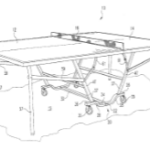
This product, which we take for granted today, was patented in the United States and invented by Bemanali H. Dadbeh [1]. Published on December 30, 2004, its contribution lies not in making the ball go faster or in making the game more sophisticated, but in making it more accessible to everyone.
This invention solved the problem of folding tables—namely, their instability and the difficulty in setting them up. Specifically, this invention introduced a self-opening mechanism that was compact and safe, facilitating the transport, storage, and use of the equipment needed to play table tennis. Thanks to this technical solution, the sport ceased to be limited to clubs or specialized venues and became a natural part of schools, community centers, and homes. It is a good reminder that intellectual property not only protects major technological revolutions but also those practical innovations that expand access to sports and make it possible for more people to play, compete, and gather around a table.
Bicycle Saddle [2] 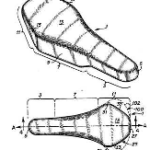
It was invented by Keith Bontrager, whose patent was published on August 11, 1994, in the United States. In cycling, the saddle is the primary point of contact between the cyclist and the bicycle, and its design directly impacts performance, comfort, and injury prevention. This invention introduced a structural and ergonomic configuration that redistributes body weight, reduces pressure on sensitive areas, and improves freedom of movement when getting on and off the bicycle. Now in the public domain, this technical development demonstrates how a solution once protected by a patent can become an industry standard, elevating both recreational and competitive cycling and reminding us that, in sports, many major transformations begin with seemingly simple details.
Adjustable Ski Goggles [3]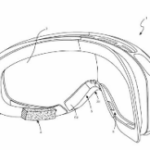
The adjustable ski goggles with a nose bridge, invented by Paolo Guadagnin and Ivo Benvegnu and published on November 13, 2014, in the United States, introduce a nose bridge system capable of adapting to different facial features, improving the frame’s fit, the goggles’ stability, and the seal against cold, wind, and snow. By solving a classic problem with winter gear—the discomfort or poor fit that affects visibility and concentration—this technical development demonstrates how industrial property protects solutions that reduce risks, especially in disciplines where the extreme environment makes every design detail a decisive factor.
Swimming Propulsion Fins [4] 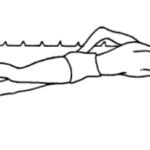
This invention, developed by Yoram Gil, was published on September 7, 1993, in the United States and proposed a design that increases the effective surface area of the swimmer’s foot through a flexible structure attached to the body, optimizing force transmission with each kick.
Beyond its competitive use, this type of fin became a key tool for technical training and physical conditioning, allowing for greater control when working on power, technique, and endurance.
Music selection based on exercise detection [5] 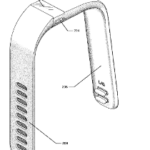
This invention, published on September 7, 1993, and owned by Fitbit Inc., illustrates how today’s major sports innovations emerge at the intersection of technology, data, and user experience. This system automatically detects the type of physical activity and the athlete’s performance, adjusting the music played in real time based on parameters such as cadence or heart rate. By eliminating the need for manual interaction, this solution improves concentration, motivation, and training consistency. Beyond being merely anecdotal, this invention demonstrates how industrial property protects developments that redefine training, integrating motion tracking, software, and entertainment to make exercise a more personalized, efficient, and engaging experience.
These inventions allow us to draw a clear conclusion: innovation in sports does not advance solely through major technological breakthroughs, but through a constant accumulation of functional improvements that redefine the relationship between the body, equipment, and the environment. From a stable folding table to a system that adapts music to heart rate, all these solutions translate human needs such as comfort, safety, and motivation into technical solutions protected by industrial property rights, specifically through the invention patent.
[1] https://worldwide.espacenet.com/publicationDetails/biblio?CC=US&NR=2004266568A1&KC=A1&FT=D&ND=&date=20041230&DB=&locale=
[2] https://worldwide.espacenet.com/publicationDetails/biblio?DB=EPODOC&II=11&ND=3&adjacent=true&locale=en_EP&FT=D&date=19941108&CC=US&NR=5362126A&KC=A
[3] https://worldwide.espacenet.com/publicationDetails/biblio?II=0&ND=3&adjacent=true&locale=en_EP&FT=D&date=20141113&CC=US&NR=2014331394A1&KC=A1
[4] https://worldwide.espacenet.com/publicationDetails/biblio?II=1&ND=3&adjacent=true&locale=en_EP&FT=D&date=19930907&CC=US&NR=5242321A&KC=A
[5] https://worldwide.espacenet.com/patent/search/family/060330208/publication/US2023112041A1?q=US2023112041


